
.jpg "avatar image")
As your business grows and scales, the need often arises to implement new processes and tools. However, clear and logical as it may seem on the roadmap, real-life implementation projects often get stuck due to:
-
Unforeseen obstacles
-
Employees’ reluctance to change their habitual practices
This is especially relevant for mid-size companies and large enterprises since a large number of factors, processes, and stakeholders are involved. If this is the case with your implementation project, then you probably need change management approaches within your implementation team or even your own change manager.
What is Change Management?
Change management is an approach aimed at facilitating changes and ensuring that they are implemented smoothly, carefully, and in full. Сhanges often have an impact on the whole enterprise and its employees.
Change managers play a crucial role by:
-
Communicating the value of innovations
-
Encouraging employees to accept and adapt to the new way of working
This article discusses the most common challenges in change management and how to overcome them by choosing the right tools.
Key Points to Remember
Any business - big or small - sooner or later is confronted with the need to change.
It's important to remember that:
-
Change is a driver of any company’s development.
-
Successful operation in the long-term perspective depends on effective change management.
The choice of a flexible solution and the right strategy for the mitigation of implementation issues - will ensure the smooth and painless change for your company, as well as the great and almost immediate results!
Scaling issues
Unlike the natural process of growth, upscaling implies rapid extension, either geographically or with regard to the product line. Often, such a process entails a whole bunch of challenges, including:
-
Limited resources
-
Communication issues
-
Management efficiency in the face of surging complexity
Before starting off with radical changes, it’s always useful to consider whether the current approaches, processes, infrastructure, or even software tools are flexible and scalable enough to fit into and, preferably, enhance the transformation. Some of the solutions that used to work well on a smaller scale, might become a burden when used in a new environment.
A good idea could be to implement scalable solutions with an upgrade potential from early on so that, when the time comes, you don’t have to spend more time, money and effort on trying to find a new solution or somehow adjust the old one. For example, with 1C:Drive, you can gradually extend the functionality of the system as your company grows. This allows for an easier and more natural change management process.
Mitigating friction
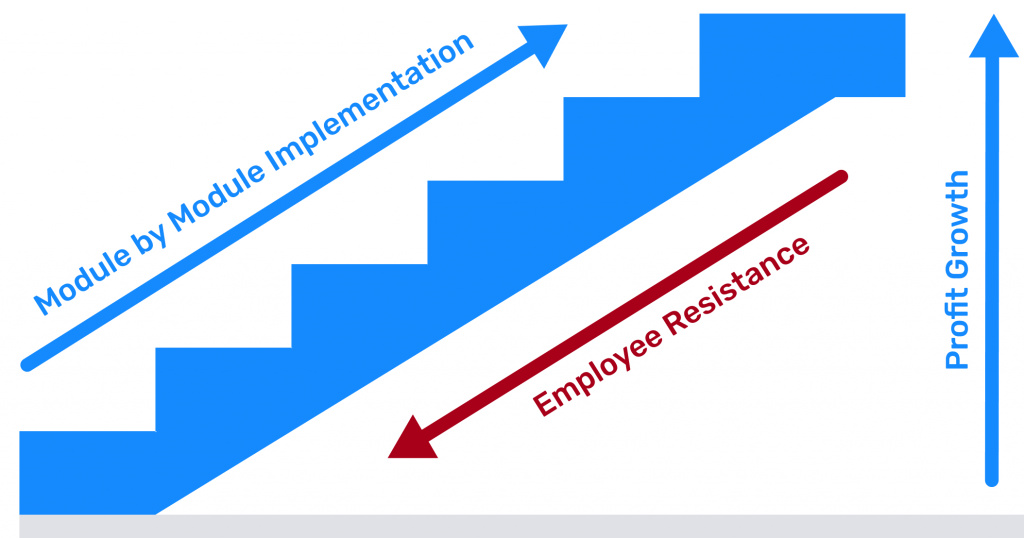
One of the most common and tricky problems when implementing new methods, processes, or tools is dealing with the so-called human factor, or employee resistance to embrace the changes. It’s a well-known psychological phenomenon, so there’s obviously nothing wrong with employees who might feel skeptical or dubious about the imposed innovations – they just need more time and a few convincing arguments to take your side.
The Psychology of Change Management
To tackle employee-related issues, it’s highly important to understand the psychological aspects of change management.
-
Soliciting support from innovative-thinking employees
-
Establishing effective communication with the rest of the team
These elements are crucial to the success of the project.
Case Study: Manufacturing Sector
For example, one of our clients, a manufacturing company, was implementing a new software tool in a number of branches. It wasn’t an easy task to do because most employees and team leads weren’t motivated enough to support the management’s initiative – except for one branch that showed positive results quite quickly. The change manager used this case as a role model for the other branches and asked their heads to share it with the employees, encouraging them to follow the suit. And so, in the end, it worked out well.
Leveraging ERP Solutions
ERP solutions like 1C:Drive can help mitigate employee resistance during the implementation phase:
-
Flexibility: It’s flexible enough and can be adjusted to the needs of different departments and teams.
-
Gradual Transition: It can be implemented gradually, module by module, so that the process goes smoothly and employees have enough time to adapt.
Considering Industry and Market Context
Another thing to take into account when planning transformation is industry-specific and market-related factors, such as:
-
Particular requirements for manufacturing standards
-
Legal documents
-
Law regulations
This is especially crucial when expanding overseas since the differences in business practices and regulations can be enormous. You cannot simply replicate your existing processes in a new market, there has to be a whole new approach.
For instance, when we adapted 1C:Drive for the Turkish market, we had to consider the local requirements for the electronic invoicing process and include this functionality in our solution. The same approach is relevant for any foreign market you’re aiming at.
If you have to use poorly localized products, a bunch of problems will arise, including:
-
Non-compliance with the local laws and requirements
-
Difficulties for foreign clients and employees
All-in-one solutions often lack flexibility and cannot be tailored to specific industrial or market requirements. This is why it might be a better idea to adopt a more customizable solution like 1C:Drive that can be easily adjusted for each particular use case.
Final thoughts
Change management can be a really demanding and sophisticated process. Apart from the challenges we’ve covered today, there’s a number of others, such as:
-
Dealing with stakeholders
-
Training employees
-
Realigning processes
The last thing you would probably want in this situation is to spend additional resources on picking and implementing new tools to fit into the new mode of business. So, this can be avoided if, at the very start, you choose scalable solutions capable of gradual, step-by-step extension and easy customization.