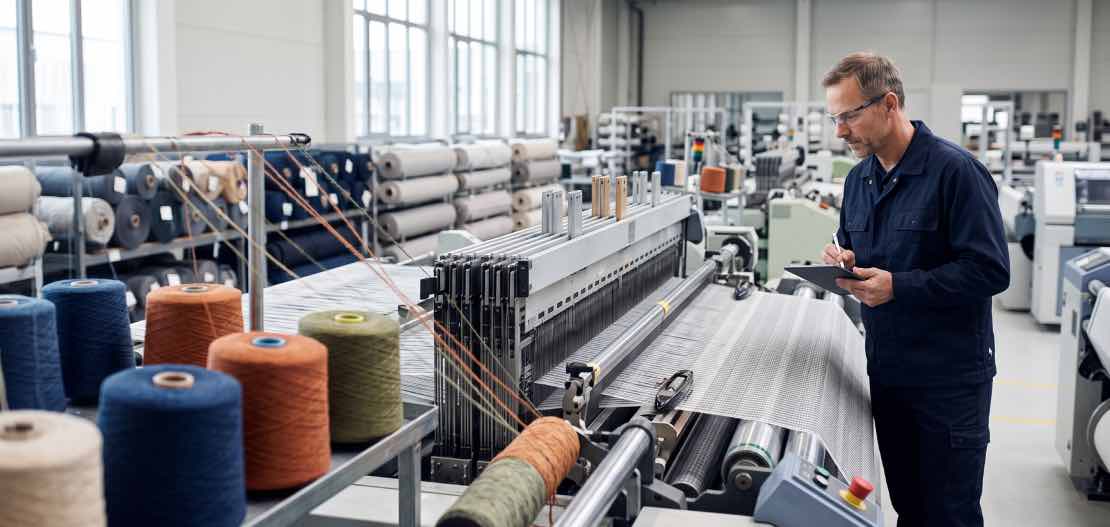

The most effective way to control production costs in textile and garment manufacturing is to focus on four areas:
-
Maximizing fabric efficiency
-
Applying lean principles
-
Using the right equipment
-
Implementing a specialized ERP system that gives real-time visibility into costs
Controlling costs in textile production requires a clear, practical approach. In a competitive and price-sensitive market, small inefficiencies in materials, labor, processes, or overhead quickly reduce profits. Companies that succeed treat cost control as an ongoing discipline rather than a one-time project.
Fabric is usually the biggest cost, often making up 60–70% of total garment costs, so better planning and cutting deliver the largest savings.
-
Use advanced CAD systems to improve marker efficiency. Even a 1–2% gain in fabric utilization can noticeably reduce waste in the cutting room.
-
Choose the exact fabric width or knit diameter needed for each product. Getting the specification right from the start avoids unnecessary edge waste.
-
Standardize trims, zippers, buttons, and linings across different styles. Higher combined volumes make it easier to meet supplier minimums and negotiate better prices.
-
Track actual fabric use against the plan and record remnants right after cutting. Regular analysis by style, fabric type, and lot turns waste into something you can actively manage.
Operational waste — extra handling, rework, and unbalanced lines — quietly increases both labor and overhead costs.
-
Focus on reducing how many times each garment is handled instead of simply cutting staff. Better factory layouts and smoother material flow cut unnecessary movement between stations.
-
Build quality into every step with a “Right First Time” approach. Inline checks after cutting, during sewing, and after finishing catch problems early and prevent expensive rework or scrap.
-
Work with designers on simpler construction. Fewer complex seams and specialty operations lower labor time and reduce the chance of operator mistakes.
-
Map the entire process and balance workloads. This reveals bottlenecks, excess work-in-progress, and idle time so you can redistribute resources for steadier flow.
Reliable equipment designed for textile production is essential for keeping costs under control over the long term.
Choose machines that can handle intensive daily use. Always check warranty terms and the availability of technical support — both have a real impact on total ownership cost.
Modern technology adds further advantages:
-
AI-powered weaving or knitting systems can optimize complex patterns and bring defect rates close to zero.
-
Predictive maintenance on sewing machines, looms, dyeing equipment, and finishing lines prevents unexpected breakdowns and costly emergency repairs.
-
Machines that connect easily to digital systems (barcode or RFID readers, sensors, MES) provide live data on performance, downtime, and energy use, supporting continuous improvement.
Well-maintained specialized machinery uses less energy, produces less scrap, delivers more consistent output, and lasts longer.
You cannot control what you do not measure accurately. Textile companies need to move beyond spreadsheets and generic accounting tools to real-time cost visibility across the whole operation.
A modern ERP built for textile and apparel automates inventory, tracks exact material yields and costs, supports lot and variant tracking, and connects financial data with production. The result is a single reliable source of truth that supports lasting cost reductions.
1C:Drive for Textile (based on the 1C:Enterprise platform) is designed for these exact needs. Its main advantages for cost control are:
-
One integrated platform instead of separate systems. Production, inventory, purchasing, sales, reporting, subcontracting, and international trade all run in the same system. Companies that previously used multiple tools usually see fewer manual errors, faster reporting, and better teamwork — which directly lowers operating costs.
-
Strong inventory management for lots and product variants. Track products by color, size, attributes, quality grade, and unique lot numbers. Real-time stock visibility by location and production stage, FIFO support, and full traceability from finished garment back to raw material help prevent overstocking, reduce obsolete inventory, and allocate material costs accurately.
-
Clear production planning, control, and costing. Manage every stage — cutting, sewing, washing, ironing, and quality control — in one place. Create production orders from sales orders, monitor machine load and material supply, handle batch or subcontract work, and calculate true order profitability, overheads, and actual versus planned costs. Estimates are replaced by solid data.
-
Real-time reporting and financial clarity. Use more than 100 ready-made reports and custom dashboards. See order profitability, net sales, P&L, inventory turns, and cost variances as they happen, not weeks later. This allows quick action on material waste, labor issues, or process problems.
-
Built-in support for international trade. Multi-currency transactions, VAT and tax handling, multi-branch and multi-warehouse management, and tools for cross-border work are included. For any company that wants to sell or buy on the global market, these features are essential — they remove manual currency conversions, simplify compliance, and keep financial data accurate across different countries and partners.
-
Flexibility for seasonal collections and changing processes. Adapt quickly to new variants, seasonal ranges, or process updates without major rework. The system supports make-to-order, make-to-stock, and mixed production, and connects easily with handheld terminals, production equipment, and e-commerce platforms.
-
Proven results in textile companies. Implementations of 1C:Drive have delivered results such as 50% fewer manual errors, 15% lower operating expenses, 50% faster management reporting, near-complete actual cost control, and better inventory efficiency. (See more details in Elif İplik customer success story)
| Challenge | 1C:Drive Solution |
| Fragmented systems and manual errors | One integrated platform for all core processes |
| Complex lots, variants, colors & sizes | Advanced inventory management with full traceability |
| Inaccurate production planning & costing | Real-time production control and precise order costing |
| Delayed reports and poor visibility | Live dashboards and 100+ ready-made reports |
| International trade complexity | Built-in multi-currency, VAT, and multi-branch support |
| Frequent seasonal and process changes | High flexibility for new collections and process updates |
By combining accurate tracking of material, labor, and overhead costs with automated workflows, a textile-focused ERP like 1C:Drive turns cost control into a continuous, everyday practice rather than a periodic accounting task.
Putting It All Together
Effective cost control in textile manufacturing is not about cutting corners. It is about systematically removing waste. Improve fabric utilization, streamline operations with lean methods, invest in reliable equipment, and support everything with a complete ERP that delivers real-time visibility and accurate costing.
| Approach | Key Actions | Main Benefit |
| 1. Maximize Fabric & Material Efficiency | Improve marker efficiency with CAD, select optimal fabric widths, standardize trims, track actual consumption and remnants | Direct reduction of the largest cost (fabric) |
| 2. Apply Lean Principles & Streamline Operations | Reduce garment handling, implement “Right First Time” quality, simplify construction (Design for Manufacturability), balance workloads | Lower labor costs, less rework and scrap, smoother flow, fewer delays |
| 3. Deploy Textile-Specific Efficient Machinery | Choose robust machines, use predictive maintenance, adopt AI/IoT solutions, integrate equipment with digital systems | Less downtime, lower energy use, fewer defects, longer equipment life |
| 4. Integrate a Modern Textile ERP (1C:Drive) | Unified platform, lot & variant inventory control, real-time production costing, live reporting, multi-currency & international trade support | Accurate cost visibility, fewer manual errors, faster decisions, scalable long-term cost control |
Companies that master these four areas protect their margins even when markets are uncertain and create a stronger base for growth. A solution designed for textile realities, such as 1C:Drive, often becomes the practical link that makes the other improvements measurable and scalable.
For more details on how 1C:Drive supports textile and apparel manufacturers, visit 1Ci Textile Solutions.