.jpg "avatar image")
In manufacturing and distribution companies, sales, warehouse, and production are often treated as separate functions. Each department may operate efficiently within its own scope, yet the lack of coordination between them creates systemic inefficiencies.
This misalignment is not always immediately visible, but it directly impacts costs, order fulfillment, and overall business performance.
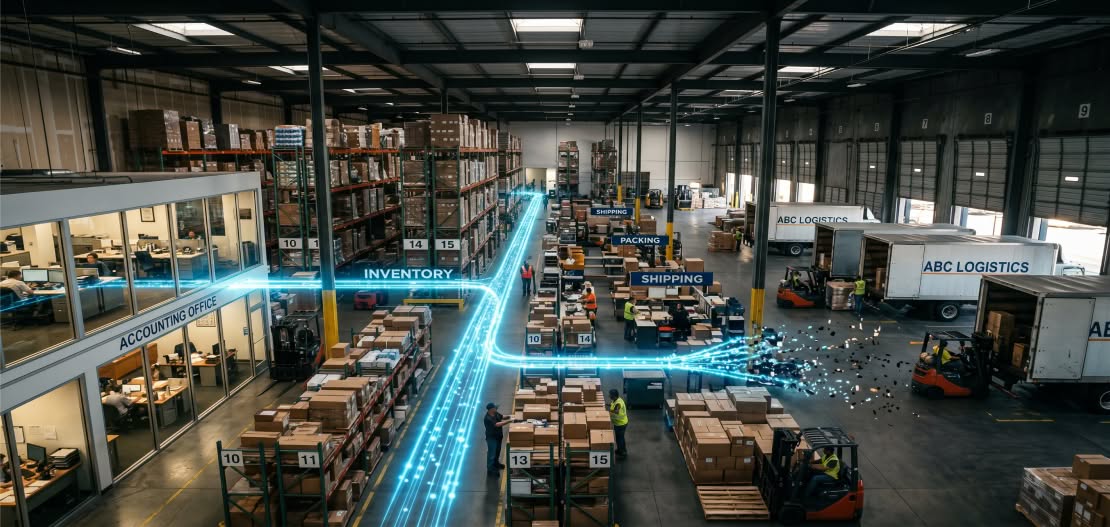
In a well-structured business, sales, inventory, and production should operate as a single, synchronized process. In practice, however, these functions are frequently managed in different systems or rely on manual coordination.
Sales teams confirm orders without full visibility into stock or production capacity. Production plans are created based on incomplete or outdated demand data. Warehouse operations reflect actual stock levels, but this information is not always available in real time to other departments.
As a result, the operational flow becomes fragmented.
One of the most common consequences of this disconnect is that orders are confirmed without a clear understanding of whether they can be fulfilled on time.
Sales teams may commit to delivery dates based on assumptions rather than actual production capacity or material availability. When production receives the order, it may lack the necessary inputs to execute it as planned.
This leads to delays, rescheduling, and additional operational pressure. In some cases, orders are partially fulfilled or postponed, affecting both revenue recognition and customer satisfaction.
The reverse situation is equally problematic. Production may operate based on internal plans or forecasts that are not fully aligned with current demand.
As a result, resources are used to produce items that are not immediately required, while high-priority orders remain unfulfilled. This creates imbalances in workload and reduces overall efficiency.
Over time, this leads to increased costs, unnecessary inventory, and reduced responsiveness to market demand.
Warehouse management often reflects the most accurate picture of actual stock. However, when this data is not integrated with sales and production, it cannot be effectively used for decision-making.
Stock levels may be:
-
insufficient for confirmed orders
-
excessive for low-demand items
-
outdated or inaccurate due to timing gaps
Without real-time synchronization, inventory becomes either a constraint or a source of unnecessary cost.
The lack of coordination between sales, warehouse, and production leads to cumulative financial losses.
Delays in production and delivery affect revenue timing and customer trust. Excess or misaligned inventory increases holding costs and ties up working capital. Inefficient use of resources reduces margins and limits scalability.
These effects are often treated as isolated issues, but they originate from a single root cause — the absence of a unified process.
At smaller scales, these inefficiencies can be managed through manual coordination. However, as order volumes increase and operations become more complex, this approach becomes unsustainable.
The number of dependencies grows, and the margin for error decreases. Without system-level alignment, the business becomes increasingly difficult to control.
What initially appears as operational friction evolves into a structural limitation.
To ensure consistency across sales, warehouse, and production, companies need a unified system that connects all three functions within a single operational model.
Such a system must:
-
provide real-time visibility into stock and production capacity
-
ensure that sales orders are validated against actual availability
-
synchronize production planning with demand
-
maintain accurate and up-to-date inventory data
-
link operational execution with financial outcomes
This level of coordination cannot be achieved through disconnected tools.
When sales, warehouse, and production operate within a single system, the business gains a synchronized flow of information and execution.
Orders are validated before confirmation. Production plans are based on actual demand and resource availability. Inventory reflects real-time movements and supports both planning and execution.
This alignment reduces uncertainty, improves efficiency, and enables predictable operations.
1C:Drive connects sales, warehouse, and production within a unified system, ensuring consistent data and process continuity.
Sales orders are linked to inventory and production capacity, allowing realistic commitments. Production planning is aligned with actual demand and material availability. Warehouse data is updated in real time and accessible across all functions.
This creates a single source of truth for all operational activities and eliminates the need for manual reconciliation between departments.
The lack of alignment between sales, warehouse, and production is not just an operational inconvenience. It directly affects costs, efficiency, and the ability to fulfill customer commitments.
As businesses grow, this disconnect becomes increasingly difficult to manage and begins to limit performance.
Establishing a unified system is essential to ensure coordination, improve resource utilization, and maintain control over operations.
This is where companies move from fragmented execution to a structured and scalable operational model.